Two years after the devastating fires of 2022, the EU-funded Interreg project takes stock. Clearance work, reforestation and new technology for real-time monitoring.
Two years have passed since the summer of 2022, when a devastating fire consumed 4,000 hectares of woodland on the Karst. Today the burned area has new hope in Karst Firewall, a cross-border Interreg project backed by more than a million euro of European Union funding. It brought the Italian and Slovenian forestry services to work side by side, with different but complementary strategies for making the area safe and restoring its ecosystem.
The Italian approach: clearance and safety
On the Italian side, around the foot of Mount Ermada and in the hamlet of Medeazza (Duino-Aurisina), the forestry service concentrated on clearing the ground. Trunks caught by the fire — now dry, unstable and highly flammable — are being removed. As Maurizio Rozza, commander of the Duino Aurisina forestry station, explains, moving the burnt biomass serves two purposes: it gives the characteristic Karst heath its space back, and it creates “slowing strips”. Should fire return, those buffer zones will hold the flames back and let emergency vehicles work effectively.
The Slovenian approach: reforestation and participation
The strategy adopted in Slovenia was entirely different and just as important. In the Merna and Rence areas the Slovenian forestry service went for reforestation. With the help of more than 6,000 volunteers, 8 tonnes of acorns and broadleaf seed — lime, field maple, downy oak and hackberry among them — were sown across 432 hectares. Branka Gasparič of the Sežana forestry service noted that 30% of the work was active replanting, leaving the remaining 70% to natural regeneration.
Technology in the service of the environment: the risk map
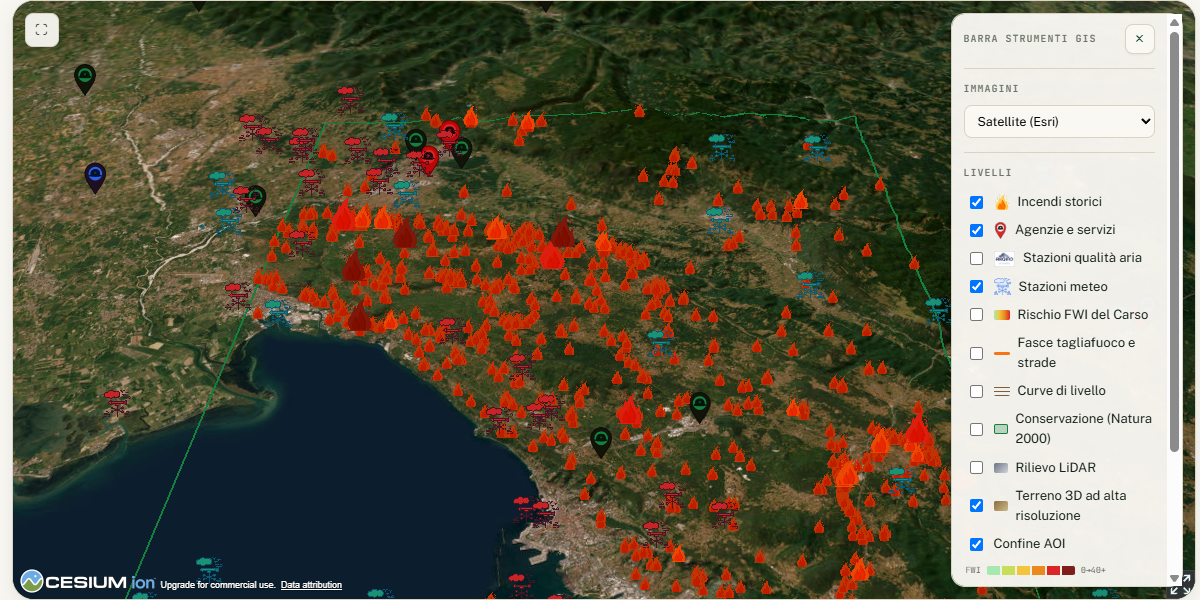
Alongside the work on the ground, the project introduced a digital prevention tool that matters: the Karst wildfire risk map. Updated in real time, it allows conditions across the area to be monitored continuously. The map is already online and open to everyone at kf50.infordata.it.
A collective project, and a demonstration that international cooperation and community effort are what turn a scar on the landscape into new resilience and environmental protection.