
AI engineering to bring artificial intelligence into business processes
- Home
- Artificial intelligence and data
- AI engineering to bring artificial intelligence into business processes
AI extends what people can do. The project stays a professional responsibility.
Artificial intelligence is changing how organisations search for information, manage documents, observe processes, support customers and make decisions. It is a significant step towards a more connected society, where people and technology work together ever more closely.
AI offers enormous opportunities: it speeds up access to knowledge, automates repetitive work, helps interpret large volumes of data, and makes available capabilities that until a few years ago were difficult or expensive to implement.
But an AI system that is genuinely useful in a company does not come out of a good prompt or an isolated prototype.
It comes from the meeting of domain knowledge, reliable data, solid architecture, security, integration and validation.
Just as AI can extend the work of lawyers, doctors, engineers or technicians without replacing their professional expertise, it can extend software, infrastructure and digital processes only when it is designed and governed by professionals who know its requirements, its limits and its responsibilities.
Experimenting is useful. Entrusting critical business systems to “vibe coding” alone is not a strategy.
It is a good thing that people without a specialist background can now approach development, build prototypes and better understand what AI makes possible. But when an idea has to become a dependable business system, it takes skills that go beyond the prototype: data security, information integrity, output quality, operational continuity, observability, performance, integrations, maintenance and validation.
AI gives us superpowers, but it does not remove the need for expertise. It makes expertise matter more.
A new service, the same approach: from technology to operational result
We have widened our range of services to support B2B customers through the transition to AI and the evolution of their digital skills.
We work alongside business, IT, security and compliance teams to identify concrete use cases, integrate AI into existing systems, and keep it observable over time.
AI engineering fits together with Infordata’s other capabilities: enterprise software, data systems, IoT, traceability, automation, computer vision, digital infrastructure and operational platforms such as GoPlanner.
The goal is not to add one more chatbot.
The goal is to make processes better informed, smoother, more automatable and above all more governable.
From feasibility to production
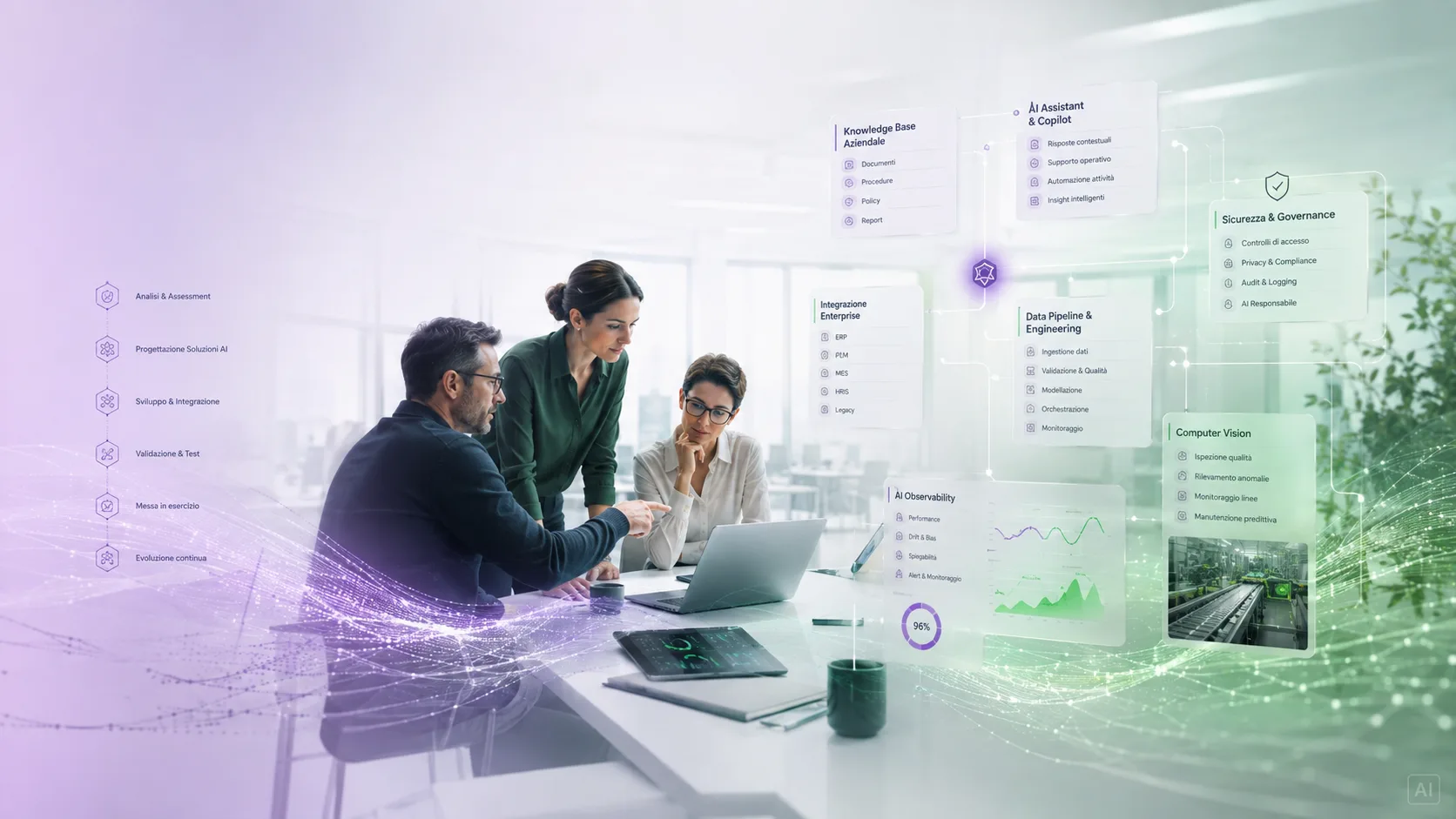
AI discovery and business priorities
We start from processes, not from the model.
We analyse objectives, users, available data, existing systems, integrations, risks and success indicators, in order to identify use cases with operational value and realistic conditions for adoption.
A good AI project begins with simple questions:
- which problem are we trying to solve;
- who will use the system;
- which data is available;
- which decisions or activities it will have to support;
- which errors are acceptable and which are not;
- how we will measure the result;
- what human oversight is required.
Design and integration
We define architectures, data flows, roles, access and control points.
We connect legacy systems, vertical applications, APIs, knowledge bases, databases and devices, with specific attention to:
- security;
- access segregation;
- data quality and provenance;
- interoperability;
- service availability;
- monitoring;
- room to evolve.
AI becomes genuinely useful when it enters processes without creating a new technology silo.
Validation and industrialisation
A prototype can work in a demo and fail in real use.
So we test:
- output quality;
- edge cases and anomalies;
- stability of results;
- response times;
- running costs;
- error handling;
- fallbacks;
- security;
- performance under real conditions.
We make the system monitorable and improvable through release procedures, observability, feedback, versioning and human oversight.
The AI services we bring to projects
AI engineering, DevOps and LLMOps
We manage the life cycle of AI applications and systems: environments, versions, configurations, prompts, models, APIs, logs, and monitoring of quality and performance.
The aim is to make AI a capability that can be managed over time, not an experiment that ends at the first release.
We can support:
- development, test and production environments;
- versioning of models and configurations;
- prompt and workflow management;
- observability;
- monitoring of errors and performance;
- control of inference costs;
- logging and technical audit;
- release and rollback processes.
AI security & guardrails
AI systems introduce new areas of risk.
We design controls to reduce problems related to:
- prompt injection;
- improper input;
- unauthorised access;
- exposure of information;
- output inconsistent with the context;
- improper use of tools;
- unhandled escalation.
The measures can include segregation, validation, filters, permission management, proportionate traceability, application policies and escalation flows.
Security is not a component added at the end: it is part of the architecture.
Data curation & synthetic data
A model is only as useful as the data and the rules that feed it.
We support:
- cleaning;
- classification;
- enrichment;
- normalisation;
- governance;
- quality;
- dataset preparation.
Where real data is scarce, confidential or hard to use, we can consider synthetic data and protection techniques.
Synthetic data is not an automatic shortcut, though: it has to be checked against quality, representativeness, privacy and the risk of re-identification.
AI agents for departments and workflows
We design AI assistants and agents that support operational activities and workflows.
For example:
- document search and classification;
- support for internal requests;
- preparing information;
- assisted completion of case files;
- administrative workflows;
- customer service support;
- procurement and supply chain activities;
- orchestration across different systems.
The level of autonomy has to be defined carefully.
An AI agent needs roles, rules, thresholds, permissions and oversight proportionate to the impact of the actions it can take.
AI compliance & RegTech
We help organisations structure inventories, documentation, controls, evidence and monitoring processes for their AI systems.
We can support the construction of:
- an inventory of AI systems;
- classification of use cases;
- technical documentation;
- change records;
- approval workflows;
- evidence of testing and validation;
- periodic checks;
- traceability of responsibilities.
The aim is to make the path towards company-wide AI governance and the applicable obligations more orderly and more governable. If you need the framework of rules, we keep it up to date on transparency and the AI Act.
The service does not replace the judgement of lawyers, DPOs, auditors or supervisory bodies.
Predictive maintenance and AI on field data
We bring together data from devices, sensors, assets and operational systems to identify patterns, anomalies and signals useful for maintenance.
In industrial and infrastructure settings, AI can support:
- intervention priorities;
- early identification of anomalies;
- monitoring of operating conditions;
- spare part availability;
- reduced downtime;
- operational continuity.
The quality of the result depends on the quality and coverage of the available data: which is why feasibility is checked before industrialisation.
Integration of legacy systems and company knowledge bases
Many companies already hold large amounts of knowledge in ERP, CRM, documents, procedures, manuals, tickets, databases and vertical systems.
AI can become a new layer of access to that knowledge.
We build:
- enterprise knowledge bases;
- semantic search engines;
- RAG systems;
- internal assistants;
- querying of documentation and procedures;
- integration with existing archives and applications.
Answers can be designed with verifiable sources, permission management and escalation paths for when AI is not enough.
Algorithmic auditing
We define methods for checking the quality, robustness, traceability, limits and possible distortions of an AI system.
A technical audit can include:
- dataset checks;
- output testing;
- analysis of edge cases;
- robustness checks;
- assessment of bias and anomalies;
- version traceability;
- performance monitoring;
- verification of fallbacks;
- documentation of known limitations.
An audit supports technical and organisational governance and is not automatically equivalent to a legal or regulatory certification, except where the specific engagement expressly provides for it.
Computer vision for quality, monitoring and maintenance
Computer vision makes it possible to identify objects, conditions and anomalies in images and video.
It can be applied to:
- quality control;
- classification;
- asset monitoring;
- analysis of environments;
- operational safety;
- maintenance;
- automated checking of conditions;
- building and validating datasets.
Computer vision is particularly useful when visual information can become structured data that integrates with other company systems.
AI and integration with the physical world
AI does not live only in documents and chatbots.
More and more often it connects to sensors, devices, cameras, identification systems, machines and infrastructure.
This is where the integration of AI, IoT, computer vision and operational systems opens new possibilities for industry, logistics, infrastructure, the environment and services.
Infordata can integrate:
- IoT and IIoT sensors;
- RFID and automatic identification systems;
- computer vision;
- data from machines and assets;
- monitoring platforms;
- ERP and management software;
- workflows and automations;
- generative AI and agents.
The value comes from the connection between data, context and action.
AI for a Society 5.0
We are entering a phase in which artificial intelligence, automation, data and connected systems will be increasingly present in business processes.
But the direction should not be technology that indiscriminately replaces people.
The direction we think is more useful is that of a Society 5.0, in which technology and human skills strengthen each other.
AI can:
- widen the capacity for analysis;
- reduce repetitive work;
- make complex knowledge accessible;
- support decisions;
- speed up design and development;
- connect systems and information that were previously separate.
But these remain essential:
- domain expertise;
- responsibility;
- critical judgement;
- validation;
- security;
- governance.
AI can speed the work up. Professional experience decides where to go, how to design the system, and when to trust the result.
What makes an AI project ready for the business
A project is ready to grow when it answers clearly a set of simple but decisive questions:
Reliable, accessible data
Which data does the system use? Where does it come from? Is it current, consistent and authorised?
Permissions and security
Who can use which data, models, tools and functions?
Integration into processes
Where does AI enter the business process, and what happens before and after it acts?
Dependable checking of outputs
Who checks the result? Which automatic and human controls are in place?
Measuring quality
How do we define whether the system is working well?
Error handling and fallbacks
What happens when the model gets it wrong, does not answer, or meets a situation nobody planned for?
Cost monitoring
What does the system cost to run, and how does that cost vary with use?
Keeping it current
How are versions, new data, process changes, model updates and regressions handled?
It is on these foundations that we build solutions that are professional, integrable, monitorable and sustainable over time.
Our approach
We do not propose AI because it is fashionable.
We introduce it when it can concretely improve a process and when the conditions exist to govern it.
Our approach brings together:
- software and infrastructure skills;
- systems integration;
- data and IoT;
- security;
- AI engineering;
- validation;
- monitoring;
- knowledge of B2B processes.
From the idea to the prototype, from the prototype to production, from production to continuous improvement.
Questions we get asked
How much does it cost?
It depends on the engagement and the scope. The readiness assessment has a fixed price because it has a fixed duration; implementations are quoted after the workshop. We do not quote against generic briefs, because the number would not be reliable.
Do we need to run your software already?
No. AI consulting is a standalone service. If our systems are there too the work is faster, but it is not a requirement.
Which models do you work with?
Those of the main vendors — Anthropic, Google, OpenAI — on an architecture that lets us switch. Where the use case requires it, we also work with open models installed on the client’s infrastructure or on ours.
Does our data leave the company?
Only if you decide it should, and in that case we write it into the contract along with the list of vendors involved. Where data cannot leave, we work with locally installed models: it costs more and performs a little less, but it can be done.
Does it qualify for Transizione 5.0 or other incentives?
Often yes, and option 6 exists for exactly that. We check eligibility before starting, not afterwards.
Do you provide training?
Yes, and it is inside the AI Act compliance support package, because Article 4 makes it an obligation for anyone using these systems. We ran it across our whole company in 2026, so we have already tested the programme.
⚠️ A note of honesty. This service line is new: we built it on capabilities we have been using internally for two years, and the first projects with external clients start in 2026. If you are looking for a supplier with twenty AI references in their pocket, that is not us. If you are looking for someone who has already taken AI into production on their own systems and knows what that involves, let’s talk.
⚠️ A note of honesty. This service line is new: it grows out of the skills and experience we have built up in-house over the past two years, while the first projects for external clients begin in 2026. If you are looking for a supplier with hundreds of AI references already in its portfolio, we are not the right fit. If, on the other hand, you are looking for a partner that has already integrated AI and taken it into production on its own systems, and that knows first-hand the opportunities, the complexities and the pitfalls of these projects, let’s talk. Our team of technicians, engineers, data scientists and physicists works with these technologies every day and is committed to continuous training and professional development.
Bring AI into your processes, with method
Do you already have a use case, or do you want to understand where AI could create value in your organisation?
We start from objectives, data, constraints and operational impact.
Request an AI discovery workshop →
Assess the feasibility of your use case →