
acquamArIna
Water quality, measured continuously and readable by anyone.
The problem
Anyone running a wastewater treatment plant, a marina or a stretch of coastline needs to know what is in the water now, not in three weeks when the laboratory report comes back. And when the answer does arrive, it is often a number in a PDF that nobody outside the laboratory can interpret.
The two problems are linked: you measure little because measuring costs, and you communicate badly because what you measure is not comprehensible.
What acquamArIna is
A platform that brings together sensors, models and communication. Probes measure continuously, a model estimates the parameters the probes do not read, and the result becomes a single number anyone can understand.
Four surfaces
The operations console — for whoever runs the plant. Live map, parameter grid, alarms in chronological order, automatic suggestions on anomalies, and a maintenance queue linked to the response procedure.
The public dashboard — for whoever has to show the results. A quality index from 0 to 100 calculated with the CCME formula, bathing water status, alignment with the Sustainable Development Goals and an ESG score. It is designed to WCAG 2.2 level AA accessibility criteria and can be used as a web page, a wall display or embedded in your own site.
The open programming interface — documented to the OpenAPI 3.1 standard and released under a Creative Commons BY 4.0 licence. The data is yours and it is reusable: by an administration for its open data portal, by a researcher for a study, by another platform for an integration.
Citizen reporting — anyone can report a problem with a photo. With protection against automated submissions, rate limiting and removal of image metadata before storage.
What it measures
Eight parameters read by probes: pH, redox potential, conductivity, turbidity, oil in water, polycyclic aromatic hydrocarbons, nitrates, chlorophyll.
Eleven parameters estimated by a model trained by pairing probe readings with laboratory samples: COD, BOD, total suspended solids, lead, cadmium, mercury, copper, zinc, nickel, arsenic, chromium.
⭐ This is where the value sits. Eleven parameters that normally require sampling and a laboratory become a continuous estimate. It does not replace official analysis — and does not claim to — but it tells you when it is worth running one.
The system detects anomalies using three statistical methods in parallel and links each parameter to the relevant regulatory reference: Italian Legislative Decree 152/2006 Table 1B, Directive 2008/105/EC on priority substances, the MARPOL convention, and Directive 2006/7/EC on bathing water.
Who it’s for
Wastewater treatment plants. The segment we are addressing first: continuous discharge monitoring, predictive maintenance on filters and membranes, and a laboratory register with sample chain of custody.
Marinas and tourist ports. The public dashboard is a reputation argument before it is a compliance one, and it helps communicate the data required in environmental certification schemes.
Public authorities. Reporting to the regional environmental agency, EU Marine Strategy obligations, and open data publication with no extra work.
How it is built
Open source software, hosted in Europe, no vendor lock-in. No proprietary mapping service, no non-European cloud: we use OpenStreetMap, a MariaDB database, RabbitMQ and MQTT message queues, and a Python model layer. The installation fits on a single server and you can take it with you.
This is not an ideological choice: it is a condition for anyone working with public environmental data, where the data has to stay accessible and reusable for longer than any supply contract lasts.
Status
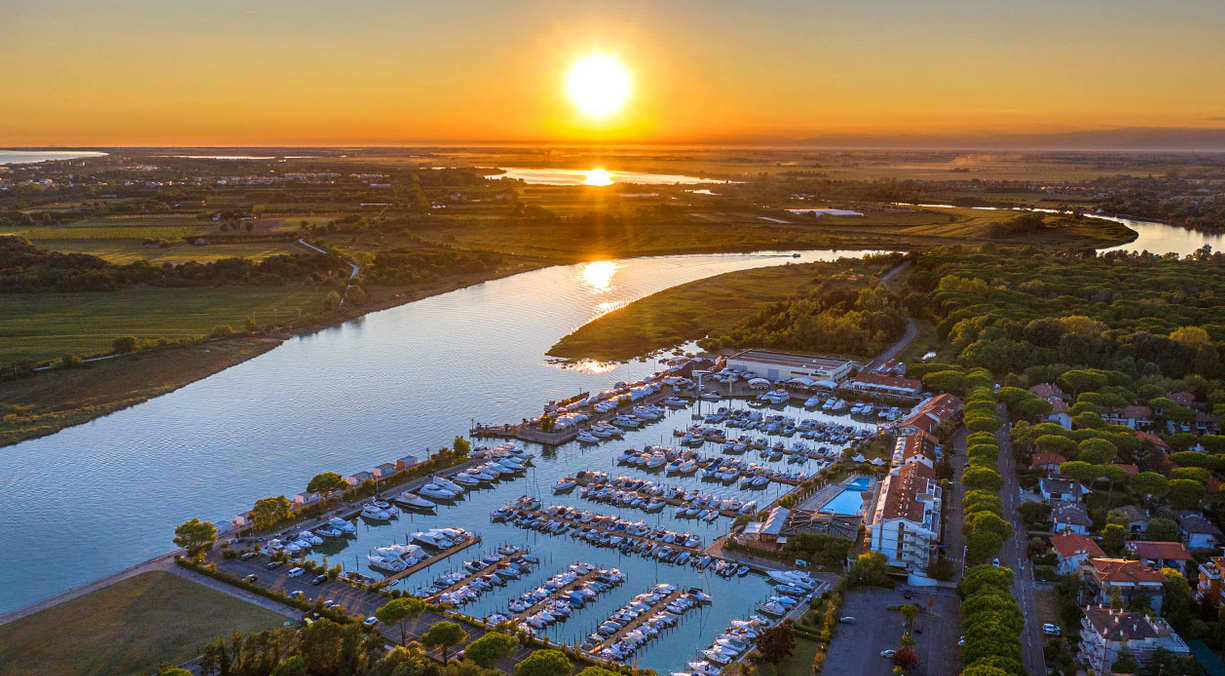
acquamArIna comes out of a research and development project co-funded by PR FESR FVG 2021-2027, action a1.3.1, and has reached technology readiness level TRL 6 with a test installation at the marina in Trieste: eight active probes and more than ninety days of historical telemetry processed.
⚠️ Productisation for the commercial catalogue is under way. If you have a plant or a stretch of water to monitor and want to be among the first, this is the right moment to talk: we follow the first installations ourselves.
Read more: Infordata sustainability → · Impact, Benefit and ESG →
Questions we get asked
Do the model-estimated parameters have legal standing?
No, and we do not claim they do. They exist to monitor continuously and to decide when to run the official analysis. Legal standing belongs to the laboratory report, which the platform manages in its laboratory module with chain of custody.
How accurate is the model?
It depends on the parameter and on how many samples it was trained on at your site. That is why the first phase of every installation is a pairing period between continuous readings and laboratory samples: without that, nobody can honestly give you a precision figure.
Can I use the probes I already have?
In many cases yes. The platform collects data over MQTT and has been integrated with more than one sensor vendor. We check against the specific model.
Is the data ours?
Yes. The open interface exists for that reason, and CC BY 4.0 is our default proposal for environmental data: if you prefer to keep it private you can, but our recommendation is to open it.
Does it need a dedicated connection?
No. The system works with whatever connectivity is available on site and handles outages by buffering data locally.
Let’s talk about your plant → · Go to research and innovation →